


A picture (graph) says a thousand words
In 2021, Jack Miller from RotoViz released an article with this graph in it:
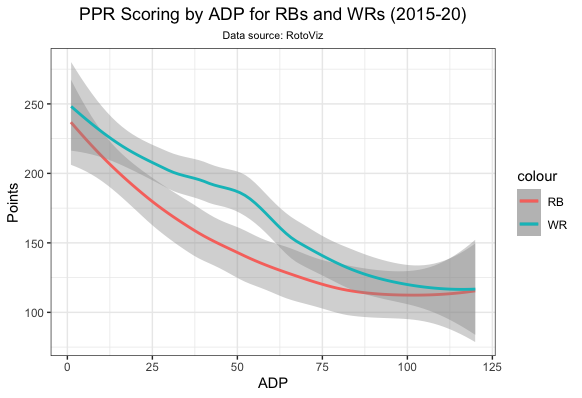
What this graph explains is that WRs outproduce RBs at every point in the draft. But see that little air bubble in the middle? The WR-RB points differential is much greater in Rounds 3-6, where WRs provide superior value above what you can find later, compared to a smaller dropoff at RB.
Miller argued that drafters should avoid RBs through these middle rounds and instead prioritise the much less fragile WRs to “win the flex”.
He titled his theory “The RB Dead Zone”.
Of course, his theory would catch on. Egged on by disappointments that year like Kerryon Johnson or Mike Davis at top-12 RB price tags, Miller’s work fanned the flames of older strategies like Zero or Hero RB and thrust them into the spotlight. This was now the meta of fantasy football.
This framework of drafting WRs through the flex has dictated every strategy I’ve used since, but in each year that passes, the market becomes more and more aware.
In 2020, 13 of the top 14 picks in full PPR were RBs but last year, only 4 were. The proliferation of these teams has become extreme — there’s no more room left for the pendulum to swing. Playoff rates of teams with 4 and 5 WRs in their first 5 picks dropped back below 50% last year for the first time since 2016.
All this to say, I’m looking to get ahead of the curve while I still can. I see this year as the last one to profit off zigging when others zag. The mid-round RB is back.
Affordability
Here’s a list of where the RB13 (high-end RB2) has been ranked on ESPN’s default PPR rankings each of the last 6 years:
2020: 2.02
2021: 2.10
2022: 2.11
2023: 3.08
2024: 3.07
2025: 4.01
That’s a 2-round drop in the last 5 years. But even just looking at the last 3 years, it’s clear if the dead-zone wasn’t dead yet, it should be now.
There’s also this stat from Ryan Heath (who we’ll discuss more later):
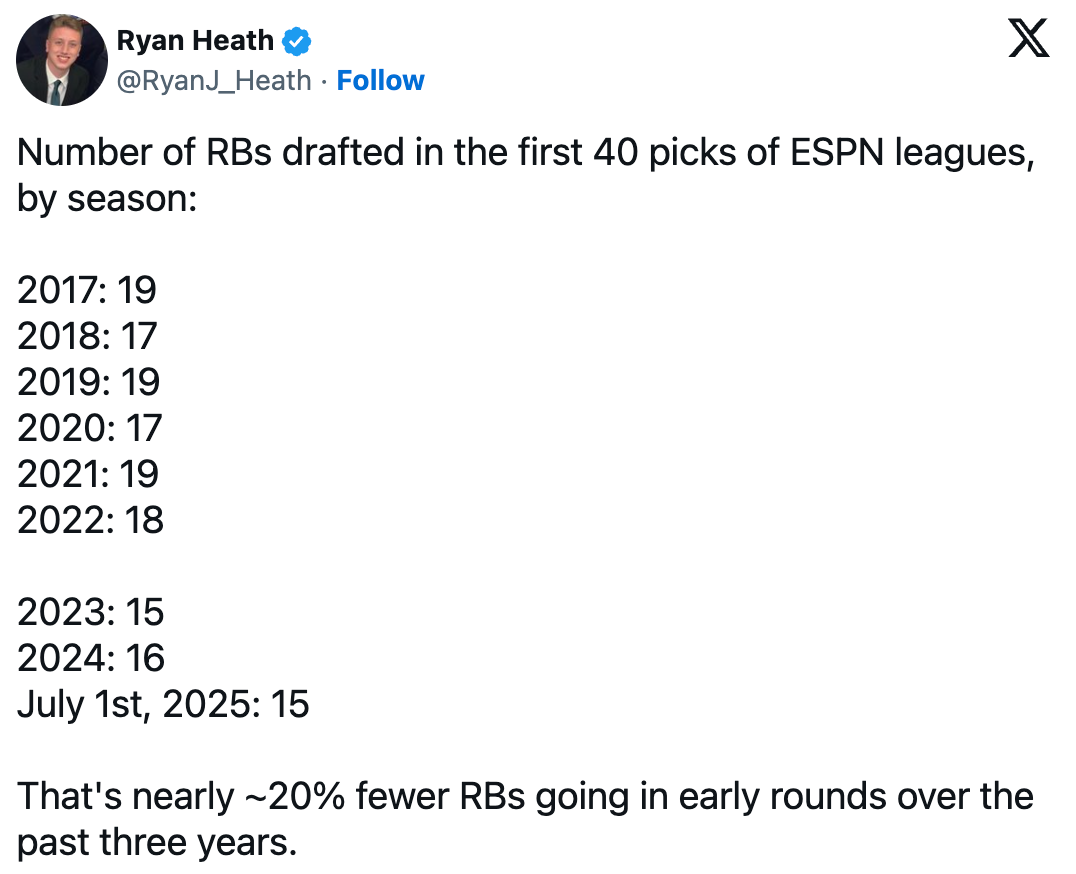
Both of these are telling us that RB2s are as cheap as they’ve ever been - even home leagues are now pricing them efficiently.
This year, looking at both Mike Clay and Rich Hribar’s projections, RBs and WRs basically project for the same amount of points as each other from Rounds 1-5. Round 6 is where the WRs begin to separate, but it’s worth noting this year, that could be because of rookies like Harvey and Henderson who are likely being drafted above where their “projection” would indicate.
Lesson here: that air bubble from above has been popped.
“Running backs get hurt more”
So we’ve established running backs are basically as cheap as ever - but that still leaves the underlying reason behind RB Zero - their fragility. Historically, RB Zero has succeeded because RBs get injured more than WRs, so as other teams’ early investments in RB fall, your team only rises in relative value (especially if you hit on a handcuff).
But is this still true? Not really.
Top 24 ADP WRs vs RBs missing 4+ games

Year       WRs         RBs

2021       6           12
2022       7           6
2023       6           8
2024       8           4
And for 2024 that doesn’t include Rice, Godwin or Higgins who all missed 4+ games.
Keen cynics among you may ask, haven’t the WRs gone up because more of them are being drafted in the top 24? Well, that’s kinda the point — maybe they shouldn’t be.
In a league where 400+ touch bellcow RBs don’t happen much anymore, and penalties are getting softer each year, I’m starting to believe our original assumption (RBs get injured more) doesn’t and won’t hold in the future. Or at least WRs are about as likely to miss games as an RB drafted around them, given each position’s new respective market pricing.
Still a need for caution
RBs may not be getting injured more than WRs anymore, but they are still less predictable…
Consider Breece Hall last season. He was, as Pat Kerrane has termed, a “silent killer”. He had a more detrimental impact on teams in terms of advancement and championship rates than players who were out for most of the season because at least for the latter, you knew you could bench them.
I’d highly recommend reading Ryan Heath’s Anatomy of a League Winner article - probably the best piece of writing from this fantasy offseason and something I’ll be referencing throughout this. Here’s a table from that article:

What this says essentially is RBs in the first 40 picks bust 26.7% more than WRs.
So while RBs aren’t getting injured as much as they used to, considering their adjusted price, the numbers say RBs are structurally less predictable (ie. introduce a higher downside risk) than WRs, regardless of price.
And this makes sense - RB is a much more opportunity-dependent position compared to WR, where even in bad offenses, talented WRs will still get open, and command targets.
RB Zero relying on waivers
The other argument for RB Zero was that each year, top 24 or even top 12 RB value could be found on waivers. Heath points out that the market has wised up to this recently, and that RB or WRs who end up starting in fantasy playoff teams, have nearly gone extinct.
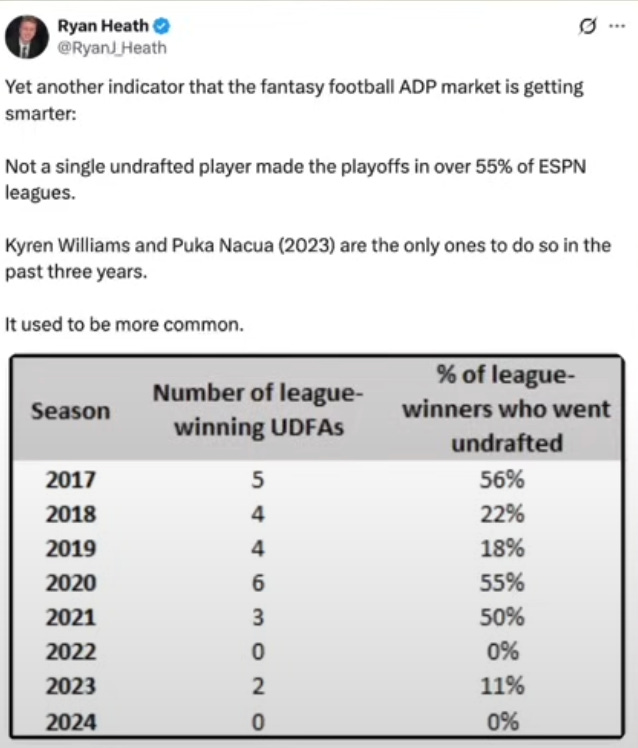
The days of 2017 Alvin Kamara or 2018 Devonta Freeman off waivers are gone. And this is particularly relevant for teams in more sharp, competitive leagues, where your edge of being more aware than leaguemates on waivers gets diminished (if someone actually does break out, you still have to fight 11 others for them).
For sharp leagues, this is also true for handcuffs and committee members — they are all getting drafted now because people have learned this contingent upside needs to be prioritised.
RB Zero truthers may argue replacement-level RB production is still able to be found off waivers. For example, the combination of Kareem Hunt, Jordan Mason and Ameer Abdullah combined to be the RB17 last year. But in the fantasy playoffs, they were outside the top 36 RBs.
This idea of RB “patchwork” off waivers is good for a quick fix but at a conceptual level, it totally contradicts the idea of RB Zero: a team that only gets stronger as the year goes on.
What to do in 2025
RBs
With that chart earlier implying RBs and WRs are equally flex-viable until Round 7, somewhere between 1 and 3 RBs in the first 6 rounds is probably optimal. After that, take as many RBs as needed for depth: if you invested multiple early picks then ease off; if you took them in Rounds 5 and 6, hammer them a bit more later on.
WRs
Lots of talk about running backs, let’s talk about wide receivers. We are still better at drafting (the right) WRs early, and we can leverage this by leaning into WR hard early. Below is another table from Ryan Heath displaying the recent trend of round 1 WRs being truly difference-making.
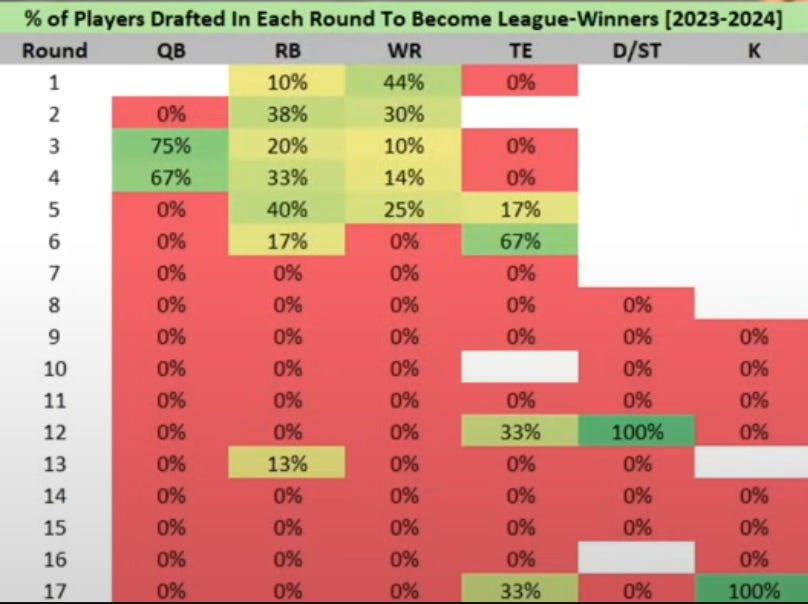
Your biggest edge at WR is now in Round 1 works nicely, knowing RBs are priced better in Rounds 2-6 than in previous years.
I see this as meaning we want to have 2-4 WRs through Round 6, and at least 4 through Round 8. After Round 6, if you are still filling out your flex spots, that’s when I would go back into leaning WR.
Once you’ve filled your flex positions, this WR lean shouldn’t hold anymore.
QBs and TEs
Just a quick comment on these for this year. Note - this is not a player takes article. this is a macro strategy view so it can still make sense to take a player if you love them/are getting a value, even if not optimal strategically.
At TE: When you take out Kelce, the data says not only is TE bad in the mid-rounds, but actually it’s always optimal to punt the position unless you get a really great value. For 2025, this is hard because Bowers, McBride and Kittle are compelling options so it really depends on how you feel about them. Just keep in mind the numbers are saying to pass though.
At QB: Either draft one of the elite guys early, or wait it out. In terms of applying it to this year, once you get past Mahomes, I would prefer to wait.
What the future holds
While RB Zero/Hero has given you an inherent edge in previous years, it’s clear that has been erased.
When we look back at the canon of fantasy football, I believe we will see the RB Zero days of the early 2020s as the extremity that it’s been: a fringe tactic which successfully exploited the community’s naivety. But the leading edge has now become the mainstream.
I’ll still be mixing in RB Zero teams here and there when opportunities present themselves, but it’s a lot harder to do. Without the need to starve yourself through Rounds 3-6, there are just way fewer spots where it makes sense to deploy.
In many leagues, I believe a balanced approach will pay dividends this year. But for those in sharper leagues like myself, I think the answer lies in predicting what the next RB-Zero is. Finding the future dominant strategy will be harder this time, given that we are in an era with much smarter market pricing. Perhaps there lies what should be exploited though…
I see pricing efficiency as near its peak. The last 15-20 years of fantasy have been based upon “value-based drafting”. The logic behind not taking a QB first-round, for example, is that even though they score the most points, there’s a smaller dropoff compared to the skill positions.
My view is that we are nearing value-based drafting’s final form. We are at an inflection point for fantasy football, and now is the time to be bold and take risks. In 5 years, we’ll be looking back thinking how wasn’t it obvious where drafting would go from here? And the answer will be because people didn’t think big enough.
As for my theory… stay tuned for the next article.